Lower Elementary, Ages 6 to 9.
For ages 6 to 9: a three-year cycle where children work at their own pace.
The Lower Elementary room
Lower Elementary at Gladwyne Montessori is for children ages 6 to 9. It is a three-year cycle that builds on the Primary years and moves into deeper academic work. Classrooms blend individualized instruction, hands-on materials, and projects that go past the surface.
Lessons come one-on-one or in small groups. Children work at their own pace toward mastery, not memorization, in advanced math, literature, science, cultural studies, and writing. Grouping by skill level, not just age, lets a child stretch in one subject and take more time in another.
Over the cycle, children practice thinking critically, asking big questions, and finishing meaningful work. They gain confidence, mastery, and curiosity that carry into the Upper Elementary years. Ask about a visit to see the room in session.
What to expect
From Foundations to Flourishing
This three-year cycle takes what children built in Primary and adds weight: more complex math, longer reading, written work with real revision. Children stay with the same teachers long enough to be known well. They push past grade-level expectations without competing against classmates. Out of that come confidence, mastery, and curiosity.
Where Academic Rigor Meets Joyful Learning
The curriculum is integrated, so science, cultural studies, and writing sit inside the same project. Lessons are given one-on-one or in small groups. Children work at their own pace to mastery rather than memorization. Grouping by skill level, not just age, lets each child stretch and be supported in every subject.
A Learning Community That Builds Confidence
Classrooms mix Grades 1 through 3. Older children mentor younger ones, and younger children watch how finished work looks. No one is held to a grade-level boundary; each child moves at their own pace. Teachers stay close, stepping in when a child needs help.
Spanish
Spanish in Lower Elementary becomes more structured. Children build on early vocabulary through conversation, games, songs, and storytelling. They start forming complete sentences, explore basic grammar, and learn about Spanish-speaking cultures. Instruction leans on speaking and listening in an immersive setting that treats language as a tool for connection.
Music
Music meets twice a week and builds on earlier rhythm and melody work. Children learn to read and write music, play pitched and unpitched instruments, and explore musical patterns and form. Singing stays central. They also begin composing and listening closely, which prepares them for more advanced music later.
Physical Education
P. E. classes start with a dynamic warm-up, then move into skill drills and cooperative games. Units cover balance, ball skills, spatial awareness, and game strategy. Children build coordination, teamwork, and personal fitness, with good sportsmanship and healthy habits reinforced along the way.
What this looks like in practice
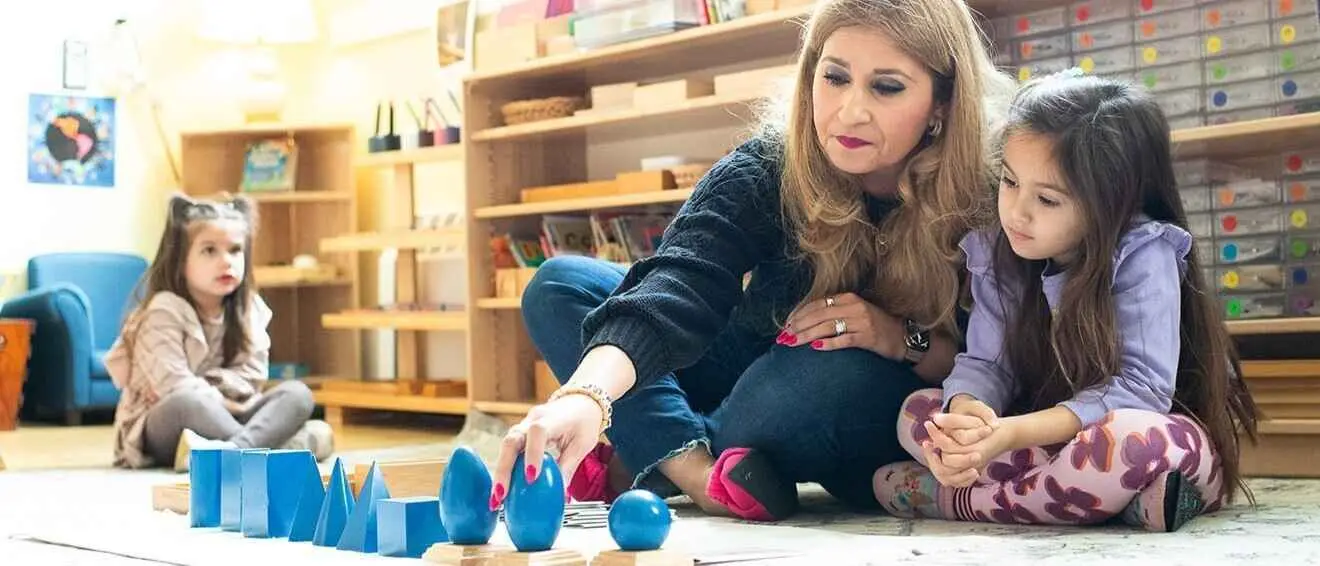
In a Lower Elementary room, you will see children working on different things at the same time. Some read on a rug. Some set up math materials on a table. A teacher kneels beside one child for a lesson, then calls a small group. Older children help younger ones without being asked.
At home, the change shows up in small ways. Your child finishes a long project without prodding. They explain how they solved a math problem, not just the answer. They read past bedtime. Those habits of working to mastery are what carry into later grades.